
 ,
Ndeye Fatou Sow,
Moussa Mareme Samba,
Papa Amath Diagne,
Cheikh Abdou Khadre Faye,
,
Ndeye Fatou Sow,
Moussa Mareme Samba,
Papa Amath Diagne,
Cheikh Abdou Khadre Faye,
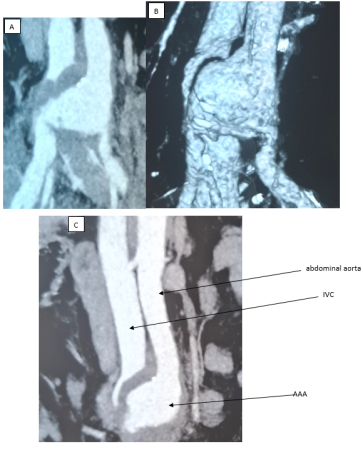
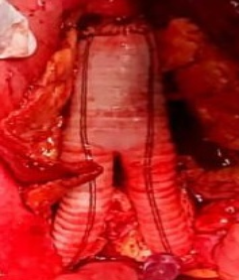
Background: Aortocaval fistula (ACF) is a rare but life-threatening complication of abdominal aortic aneurysm (AAA), occurring in approximately 1% of all AAAs and up to 6% of ruptured cases. It results from progressive erosion of the aneurysmal wall into the inferior vena cava, creating a pathological arteriovenous communication that may lead to high-output cardiac failure, venous hypertension, and renal dysfunction. Because clinical manifestations are highly variable, diagnosis is often delayed. Computed tomography angiography remains the diagnostic modality of choice, allowing visualization of early venous opacification and characterization of aneurysm morphology. Case Presentation: We report the case of a 65-year-old woman presenting with acute abdominal pain and exertional dyspnea. CT angiography demonstrated a 68-mm infrarenal ruptured AAA with early opacification of the inferior vena cava, confirming an ACF. Despite the rupture, the patient remained hemodynamically stable, with preserved renal function and normal laboratory parameters. Management: Emergency open surgical repair was performed through a midline laparotomy. After proximal and distal vascular control, the aneurysm sac was opened, revealing a large fistulous defect on the right posterolateral aortic wall. The venous defect was closed with interrupted sutures, followed by an aortobi-iliac bypass using a bifurcated prosthetic graft. Postoperative recovery was uneventful, and the patient was discharged on postoperative day 8. At 30-day follow-up, she remained asymptomatic, and Doppler ultrasound confirmed graft patency without residual arteriovenous communication. Conclusion: Aortocaval fistula remains an uncommon but severe complication of infrarenal AAA. Early recognition and prompt surgical intervention are essential to reduce morbidity and mortality. While endovascular repair is an emerging alternative in selected patients, open repair continues to be the standard approach in many settings, particularly where endovascular resources are limited or when the fistula is large or anatomically complex.
| Published in | International Journal of Cardiovascular and Thoracic Surgery (Volume 12, Issue 2) |
| DOI | 10.11648/j.ijcts.20261202.18 |
| Page(s) | 70-74 |
| Creative Commons |
This is an Open Access article, distributed under the terms of the Creative Commons Attribution 4.0 International License (http://creativecommons.org/licenses/by/4.0/), which permits unrestricted use, distribution and reproduction in any medium or format, provided the original work is properly cited. |
| Copyright |
Copyright © The Author(s), 2026. Published by Science Publishing Group |
Aortocaval Fistula, Abdominal Aortic Aneurysm, Aneurysm Rupture, Open Surgical Repair, Endovascular Aneurysm Repair
Study / Reference | Number of cases | Mean age | Dominant clinical presentation | Preoperative diagnosis | Treatment | Mortality |
|---|---|---|---|---|---|---|
Brewster et al., 1991 [1] | 18 | 67 years | Heart failure, abdominal pain | 50% | Open repair | 22% |
Davidovic et al., 2005 [2] | 25 | 64 years | Pain, shock, continuous bruit | 48% | Open repair | 28% |
Saers & Scheltinga, 2005 [4] | 81 (review) | 65 years | Classic triad <50% | 40–50% | Open repair | 30–50% |
Antoniou et al., 2009 [3] | 22 | 69 years | Heart failure, pain | 55% | EVAR | 10–15% |
Hinchliffe et al., 2002 [ 8] | 3 | 71 years | Heart failure | 67% | EVAR | 0% |
Kopp et al., 2002 [7] | 7 | 68 years | Pain, hypotension | 43% | Open repair | 29% |
Sohail et al., 2023 [1 5] | 1 | 73 years | Incidental ACF in unruptured AAA, minimal symptom | 100% | EVAR | 0% |
Gomes et al., 2023 [1 6] | 1 | 72 | Abdominal pain, heart failure signs, ruptured AAA | 100% | EVAR | 0% |
Vaz Dias et al., 2024 [1 7] | 1 | 79 | Generalized edema, dyspnea, abdominal pain, | 100% | EVAR | 0% |
Oderich et al., 2010 (case series, endovascular caution) [1 8] | 3 | 65-78 years | Heart failure, abdominal pain, high-output state | 67% | EVAR | 0 – 33% |
Present case | 1 | 65 years | Acute abdominal pain, exertional dyspnea | 100% | Open repair | 0% |
AAA | Abdominal Aortic Aneurysm |
ACF | Aortocaval Fistula |
AVF | Arteriovenous Fistula |
BP | Blood Pressure |
CT | Computed Tomography |
CTA | Computed Tomography Angiography |
DVT | Deep Venous Thrombosis |
EVAR | Endovascular Aneurysm Repair |
HF | Heart Failure |
HR | Heart Rate |
ICU | Intensive Care Unit |
IVC | Inferior Vena Cava |
POD | Postoperative Day |
RR | Respiratory Rate |
SpO2 | Peripheral Oxygen Saturation |
| [1] | Brewster DC, Cambria RP, Moncure AC, Darling RC, LaMuraglia GM, Geller SC. Aortocaval and iliac arteriovenous fistulas: recognition and treatment. J Vasc Surg. 1991; 13(2): 253-64. |
| [2] | Davidovic LB, Markovic DM, Kostic DM, Maksimovic Z, Cinara IS, Markovic M. Aortocaval fistulas: a review of 25 patients. Cardiovasc Surg. 2002; 10(6): 530-5. |
| [3] | Antoniou GA, Koutsias S, Karathanos C, Sfyroeras GS, Vretzakis G, Giannoukas AD. Endovascular stent-graft repair of major abdominal arteriovenous fistula: a systematic review. J Endovasc Ther. 2009; 16(4): 514-23. |
| [4] | Saers SJ, Scheltinga MR. Aortocaval fistula: a rare complication of an abdominal aortic aneurysm. Eur J Vasc Endovasc Surg. 2005; 30(4): 429-37. |
| [5] | Tellez L, Cervera R, Esteban E, Martínez-Sánchez P, García-García A, Castañer E. Aortocaval fistula: clinical features and CT findings. Emerg Radiol. 2012; 19(4): 341-5. |
| [6] | Wanhainen A, Verzini F, Van Herzeele I, Allaire E, Bown M, Cohnert T, et al. ESVS 2019 Clinical Practice Guidelines on the management of abdominal aorto-iliac artery aneurysms. Eur J Vasc Endovasc Surg. 2019; 57(1): 8-93. |
| [7] | Kopp R, Wizgall I, Kreuzer E, Meimarakis G, Weidenhagen R, Kühnl A. Aortocaval fistula: an uncommon complication of infrarenal aortic aneurysms. Vasa. 2002; 31(3): 195-9. |
| [8] | Hinchliffe RJ, Braithwaite BD, Hopkinson BR. The management of aortocaval fistula by endovascular stent-grafting. Eur J Vasc Endovasc Surg. 2002; 23(5): 475-6. |
| [9] | D’Souza J, Halandras PM, Bechara CF. Aortocaval fistula: a rare complication of abdominal aortic aneurysm. Ann Vasc Surg. 2017; 38: 317. e1-317. e5. |
| [10] | Brewster DC. Clinical and pathophysiologic considerations in aortocaval fistulas. Semin Vasc Surg. 1995; 8(4): 321-8. |
| [11] | Chaikof EL, Dalman RL, Eskandari MK, Jackson BM, Lee WA, Mansour MA, et al. SVS practice guidelines on the care of patients with an abdominal aortic aneurysm. J Vasc Surg. 2018; 67(1): 2-77. e2. |
| [12] | Lee WA, Nelson PR, Berceli SA, Seeger JM, Huber TS. Outcome after endovascular repair of abdominal aortic aneurysms with aortocaval fistula. J Vasc Surg. 2008; 48(1): 15-9. |
| [13] | Smith RB, Perdue GD, Hollier LH, Bernatz PE, Pairolero PC, Cherry KJ. Aortocaval fistula: a complication of abdominal aortic aneurysms. Surgery. 1981; 89(2): 243-9. |
| [14] | Greenberg RK, Clair D, Srivastava S, Bhandari G, Turc A, Hampton J, et al. Should patients with challenging anatomy be offered endovascular aneurysm repair? J Vasc Surg. 2004; 40(3): 435-44. |
| [15] | Sohail AH, Cohen K, Ho K, Cimaroli S, Brathwaite CEM, Shin P. Incidental aortocaval fistula in the setting of an unruptured abdominal aortic aneurysm. J Surg Case Rep. 2023; 2023(7): rjad384 |
| [16] | Gomes KEB, Sanvesso EK, Joviliano EE, Ribeiro MS, Zampieri EHS. Aortocaval fistula: a rare complication of ruptured abdominal aortic aneurysm. Arq Bras Cardiol: Imagem cardiovasc. 2023; 36(2): e369. |
| [17] | Vaz Dias M, Patrão P, Cardoso D, Almeida A. Aortocaval fistula: a rare complication of abdominal aortic aneurysm. Eurorad. 2024; Case 18657. |
| [18] | Oderich GS, Panneton JM, Bower TC, Cherry KJ, Sullivan TM, Noel AA, et al. Endovascular repair of aortocaval fistula: a word of caution. J Vasc Surg. 2010; 51(2): 284-93. |
APA Style
Thiaw, A. A., Sow, N. F., Mbengue, A. L., Samba, M. M., Diagne, P. A., et al. (2026). Ruptured Infrarenal Abdominal Aortic Aneurysm with Aortocaval Fistula: Open Surgical Repair and Clinical Outcome. International Journal of Cardiovascular and Thoracic Surgery, 12(2), 70-74. https://doi.org/10.11648/j.ijcts.20261202.18
ACS Style
Thiaw, A. A.; Sow, N. F.; Mbengue, A. L.; Samba, M. M.; Diagne, P. A., et al. Ruptured Infrarenal Abdominal Aortic Aneurysm with Aortocaval Fistula: Open Surgical Repair and Clinical Outcome. Int. J. Cardiovasc. Thorac. Surg. 2026, 12(2), 70-74. doi: 10.11648/j.ijcts.20261202.18
@article{10.11648/j.ijcts.20261202.18,
  author = {Abdoul Aziz Thiaw and Ndeye Fatou Sow and Abdou Lahat Mbengue and Moussa Mareme Samba and Papa Amath Diagne and Momar Sokhna Diop and Dialtabe Ibrahima Ba and Mory Camara and Abdou Khoudouss Diallo and Mareme Soda Mbaye and Moussa Seck Diop and Anta Mbaye Sall and Cheikh Abdou Khadre Faye and Amadou Dioulde Diallo and Pape Ousmane Ba and Magaye Gaye and Souleymane Diatta and Papa Salmane Ba and Papa Adama Dieng and Amadou Gabriel Ciss},
  title = {Ruptured Infrarenal Abdominal Aortic Aneurysm with Aortocaval Fistula: Open Surgical Repair and Clinical Outcome},
  journal = {International Journal of Cardiovascular and Thoracic Surgery},
  volume = {12},
  number = {2},
  pages = {70-74},
  doi = {10.11648/j.ijcts.20261202.18},
  url = {https://doi.org/10.11648/j.ijcts.20261202.18},
  eprint = {https://article.sciencepublishinggroup.com/pdf/10.11648.j.ijcts.20261202.18},
  abstract = {Background: Aortocaval fistula (ACF) is a rare but life-threatening complication of abdominal aortic aneurysm (AAA), occurring in approximately 1% of all AAAs and up to 6% of ruptured cases. It results from progressive erosion of the aneurysmal wall into the inferior vena cava, creating a pathological arteriovenous communication that may lead to high-output cardiac failure, venous hypertension, and renal dysfunction. Because clinical manifestations are highly variable, diagnosis is often delayed. Computed tomography angiography remains the diagnostic modality of choice, allowing visualization of early venous opacification and characterization of aneurysm morphology. Case Presentation: We report the case of a 65-year-old woman presenting with acute abdominal pain and exertional dyspnea. CT angiography demonstrated a 68-mm infrarenal ruptured AAA with early opacification of the inferior vena cava, confirming an ACF. Despite the rupture, the patient remained hemodynamically stable, with preserved renal function and normal laboratory parameters. Management: Emergency open surgical repair was performed through a midline laparotomy. After proximal and distal vascular control, the aneurysm sac was opened, revealing a large fistulous defect on the right posterolateral aortic wall. The venous defect was closed with interrupted sutures, followed by an aortobi-iliac bypass using a bifurcated prosthetic graft. Postoperative recovery was uneventful, and the patient was discharged on postoperative day 8. At 30-day follow-up, she remained asymptomatic, and Doppler ultrasound confirmed graft patency without residual arteriovenous communication. Conclusion: Aortocaval fistula remains an uncommon but severe complication of infrarenal AAA. Early recognition and prompt surgical intervention are essential to reduce morbidity and mortality. While endovascular repair is an emerging alternative in selected patients, open repair continues to be the standard approach in many settings, particularly where endovascular resources are limited or when the fistula is large or anatomically complex.},
 year = {2026}
}
TY  - JOUR
T1  - Ruptured Infrarenal Abdominal Aortic Aneurysm with Aortocaval Fistula: Open Surgical Repair and Clinical Outcome
AU  - Abdoul Aziz Thiaw
AU  - Ndeye Fatou Sow
AU  - Abdou Lahat Mbengue
AU  - Moussa Mareme Samba
AU  - Papa Amath Diagne
AU  - Momar Sokhna Diop
AU  - Dialtabe Ibrahima Ba
AU  - Mory Camara
AU  - Abdou Khoudouss Diallo
AU  - Mareme Soda Mbaye
AU  - Moussa Seck Diop
AU  - Anta Mbaye Sall
AU  - Cheikh Abdou Khadre Faye
AU  - Amadou Dioulde Diallo
AU  - Pape Ousmane Ba
AU  - Magaye Gaye
AU  - Souleymane Diatta
AU  - Papa Salmane Ba
AU  - Papa Adama Dieng
AU  - Amadou Gabriel Ciss
Y1  - 2026/03/28
PY  - 2026
N1  - https://doi.org/10.11648/j.ijcts.20261202.18
DO  - 10.11648/j.ijcts.20261202.18
T2  - International Journal of Cardiovascular and Thoracic Surgery
JF  - International Journal of Cardiovascular and Thoracic Surgery
JO  - International Journal of Cardiovascular and Thoracic Surgery
SP  - 70
EP  - 74
PB  - Science Publishing Group
SN  - 2575-4882
UR  - https://doi.org/10.11648/j.ijcts.20261202.18
AB  - Background: Aortocaval fistula (ACF) is a rare but life-threatening complication of abdominal aortic aneurysm (AAA), occurring in approximately 1% of all AAAs and up to 6% of ruptured cases. It results from progressive erosion of the aneurysmal wall into the inferior vena cava, creating a pathological arteriovenous communication that may lead to high-output cardiac failure, venous hypertension, and renal dysfunction. Because clinical manifestations are highly variable, diagnosis is often delayed. Computed tomography angiography remains the diagnostic modality of choice, allowing visualization of early venous opacification and characterization of aneurysm morphology. Case Presentation: We report the case of a 65-year-old woman presenting with acute abdominal pain and exertional dyspnea. CT angiography demonstrated a 68-mm infrarenal ruptured AAA with early opacification of the inferior vena cava, confirming an ACF. Despite the rupture, the patient remained hemodynamically stable, with preserved renal function and normal laboratory parameters. Management: Emergency open surgical repair was performed through a midline laparotomy. After proximal and distal vascular control, the aneurysm sac was opened, revealing a large fistulous defect on the right posterolateral aortic wall. The venous defect was closed with interrupted sutures, followed by an aortobi-iliac bypass using a bifurcated prosthetic graft. Postoperative recovery was uneventful, and the patient was discharged on postoperative day 8. At 30-day follow-up, she remained asymptomatic, and Doppler ultrasound confirmed graft patency without residual arteriovenous communication. Conclusion: Aortocaval fistula remains an uncommon but severe complication of infrarenal AAA. Early recognition and prompt surgical intervention are essential to reduce morbidity and mortality. While endovascular repair is an emerging alternative in selected patients, open repair continues to be the standard approach in many settings, particularly where endovascular resources are limited or when the fistula is large or anatomically complex.
VL  - 12
IS  - 2
ER  -
Thoracic and Cardiovascular Surgery Department, National University Hospital Center of Fann, Dakar, Senegal
Thoracic and Cardiovascular Surgery Department, National University Hospital Center of Fann, Dakar, Senegal
Thoracic and Cardiovascular Surgery Department, National University Hospital Center of Fann, Dakar, Senegal
Thoracic and Cardiovascular Surgery Department, National University Hospital Center of Fann, Dakar, Senegal
Thoracic and Cardiovascular Surgery Department, National University Hospital Center of Fann, Dakar, Senegal



 Share This Article
 Twitter
 Linked In
 Facebook
 Copy
Copy Download